Pipe mounting
For pipe mounting one of the mounting kits listed in the table below is required. The mounting kits differ only in the length of the swivel arm included. This also determines the distance between the contact surface of the flange and the centre of the sensor recess. The mounting kits listed in the table below are suitable for pipes with a diameter of 50-275 mm. For thinner pipes the mounting kits listed in chapter Strut/rod mounting can be used.
| Radar pipe mounting kit | Radar pipe mounting kit long | |
|---|---|---|
| Item number | 301481 | 400407 |
| Length of the swivel arm | 140 mm | 390 mm |
| Flange contact surface to centre sensor recess | 240 mm | 490 mm |
|
|
| How-To-Video: Pipe mounting |
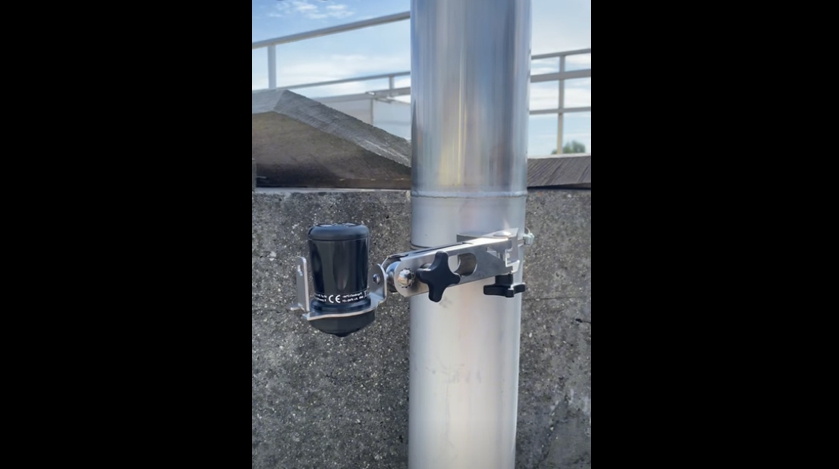

Pipe mounting
| 1 | Tightening strap (for 50-275 mm pipe diameter) | 4 | Clamping screw |
| 2 | Flange for pipe mounting | 5 | Swivel arm |
| 3 | Bolt head fitted with a lock pin |
- Thread the tensioning strap through the appropriate openings in the flange (see illustration Attaching the flange on the pipe).
- Position the flange on the pipe and use the tensioning strap to fasten it.
- Attach the swivel arm to the flange already mounted on the pipe using the clamping
screw (consisting of the star knob and the coach bolt fitted with a lock pin in the bolt
head).
Thanks to the locking pin that is fitted on the bolt head and the holes on the front edge of the flange, the swivel arm can be locked in 15° increments at an angle of up to 90° relative to the centre axis. This applies to both left and right rotation. If a different angle is required, you can also insert the screw so that the locking pin engages in the elongated hole in the flange. In this case, however, the resistance to twisting of the swivel arm is determined only by the clamping force generated by the clamping screw.
Tip: The swivel arm is designed in such a way that the orientation of the clamping screw (star knob at the top or bottom) is irrelevant.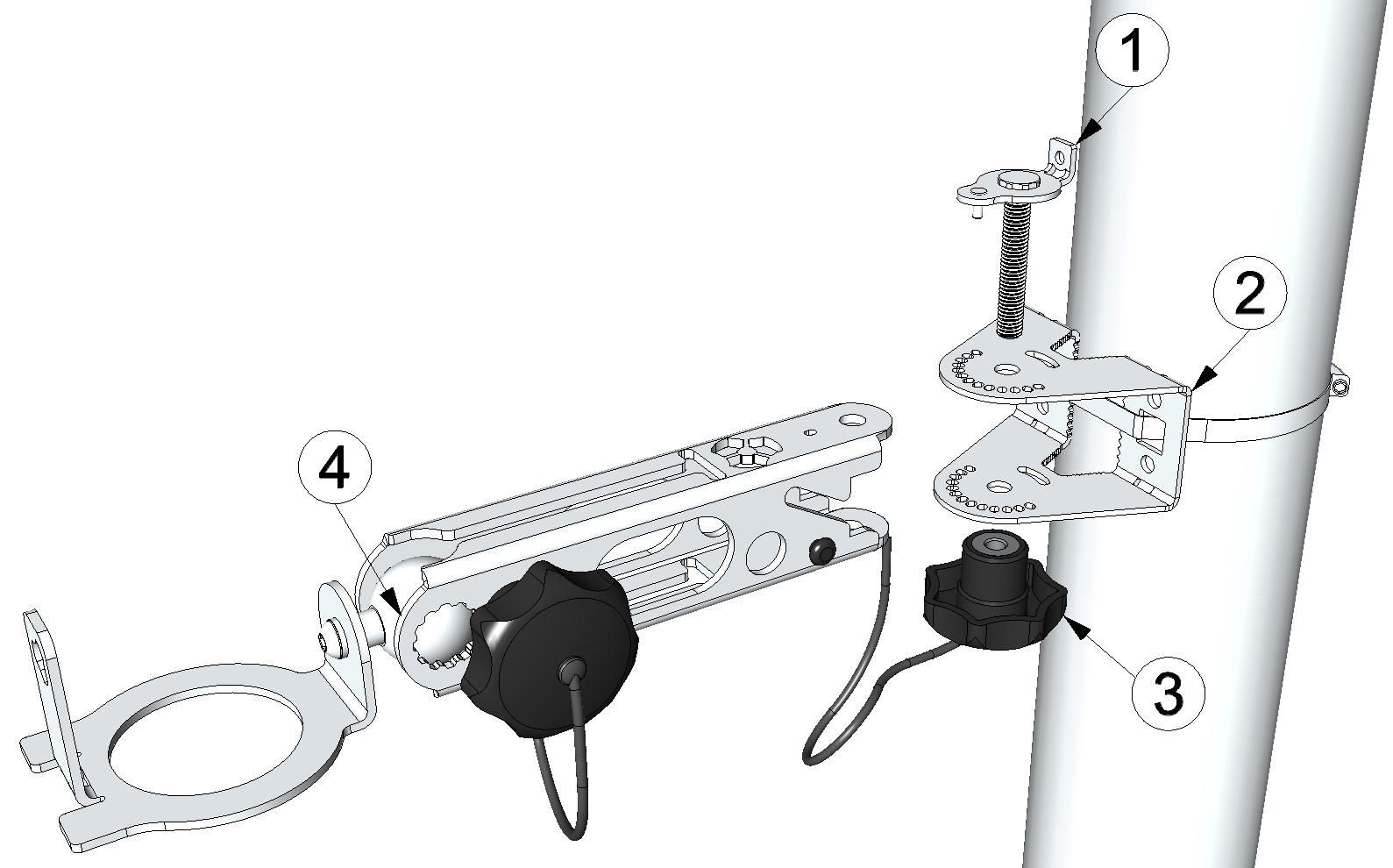
Attaching the swivel arm to the flange
1 Coach bolt fitted with a lock pin in the bolt head 3 Star knob 2 Flange for pipe mounting 4 Swivel arm - Insert the VEL‑R‑5 in the sensor recess of the swivel arm and align it correctly. Detailed instructions on this are provided in chapter Flexibly adjustable mounts.


