Functional principle
In the graphic below, all of the components that are part of the myDatanet are illustrated in grey. All of the other components must be provided/created by the customer.
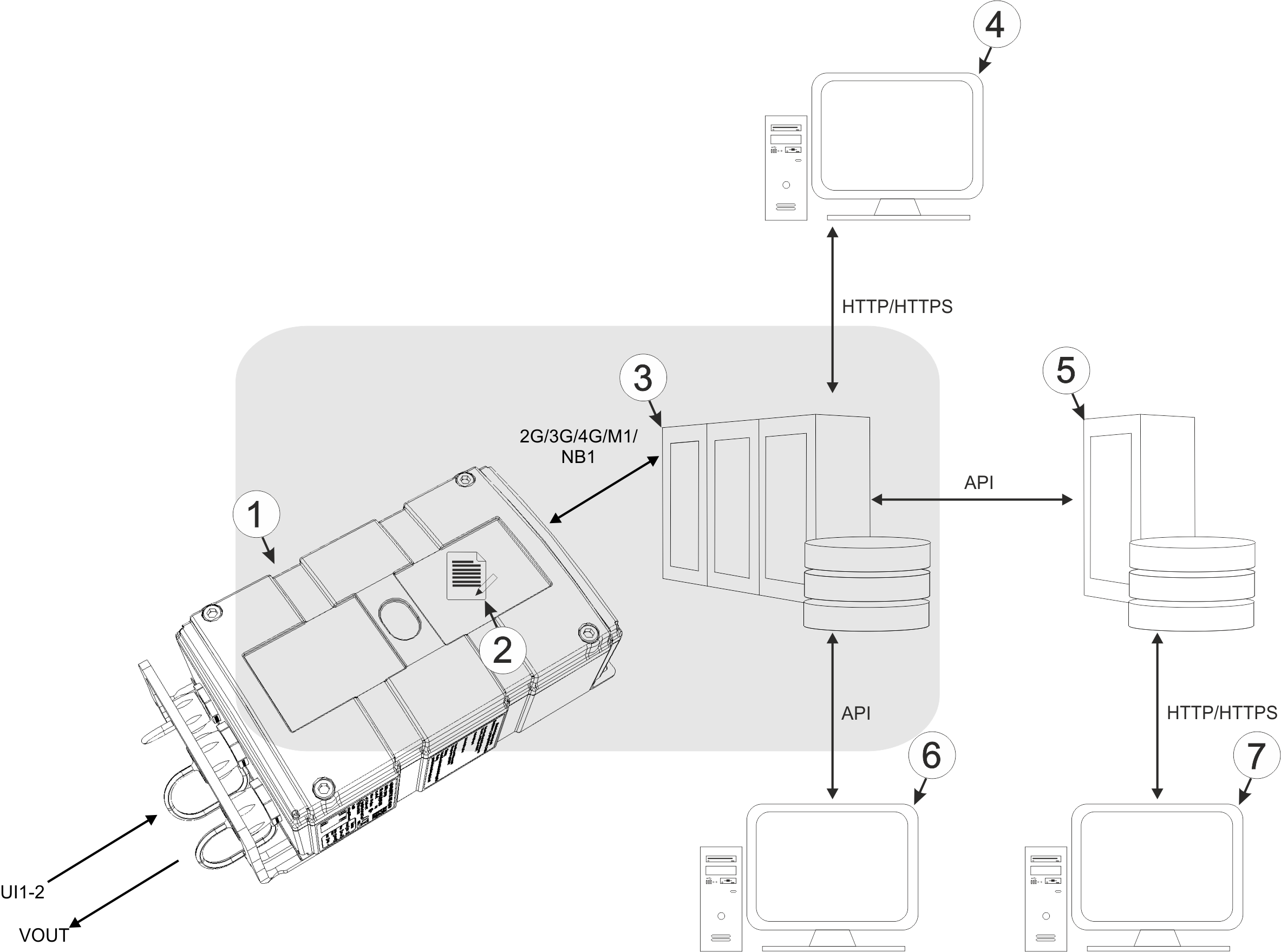
Functional principle
| 1 | myDatalogEASY IoT with integrated managed service SIM chip (including data transmission) |
| 2 | "myDatalogEASY IoT ATEX IoT application" |
| 3 | myDatanet server to which the data is transferred |
| 4 | Client that accesses the interface of the myDatanet server via the web browser |
| 5 | Customer-specific server that provides clients with their own interface. The customer-specific server obtains the data via the API of the myDatanet server (see API). |
| 6 | Client, on which a PC program is running, that obtains its data via the API of the myDatanet server (see API) |
| 7 | Client that accesses the interface of the customer-specific server via the web browser |
Functions and components provided by myDatanet :
- myDatalogEASY IoT with
installed IoT application "myDatalogEASY IoT ATEX"
Portable device with integrated memory and standardised industrial interfaces (UI1-2) for connecting sensors to the myDatanet server (2G/3G/4G/M1/NB1)
- Managed Service
Managed Service is the basis for operating the devices and provides a wide range of services. Managed Service includes updates for device firmware, mobile data transmission on a global scale and free support - providing you with one contact person for the entire solution.
- myDatanet server
Database for saving the measurement data and configurations. Data is either accessed via the API (see API) or the web interface of the server.
Functions and components provided by the customer
- Sensors
Sensors that include interfaces that are compatible with the specifications listed in the chapter "Specifications" (see Specifications).
- Customer-specific server with web interface for the clients (optional)
It is therefore possible to create an individual web interface for the clients. Using this method, the data is read out of the myDatanet server via the API (see API) by the customer-specific server.


