Technical details about the RS485 interface
- The RS485 interface corresponds to standard EIA-485.
The RS485 interface of the Lizzox Pure Flood includes an input common mode range that covers the full area specified for RS485 (-7 V...+12 V). Higher voltages damage the interface. Differential signals of more than +/-200 mV within the specified input common mode range are detected correctly. In send mode, the output signal is in the range of 1,5...3,3 V .
| Baud rate | 600-115200 |
| Stop bits | 1, 2 |
| Parity | N, E, O |
| Data bits | 7, 8 |
| Load resistance |
Off 120 Ω |
Via the dropdown list "Termination", located in the "Interfaces" Tab of the input window "Device settings", the 120 Ω termination resistance between RS485 A and B can be switched on. (See Device settings )
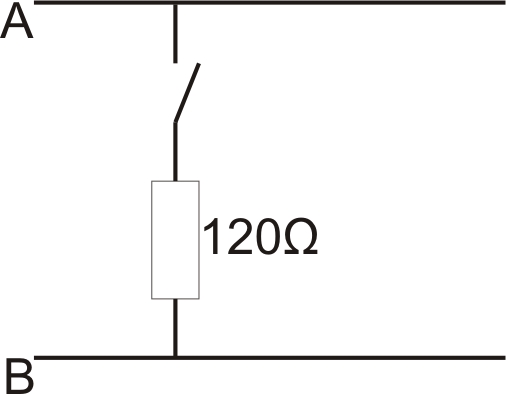
Schematic diagram of the switchable load resistance
The RS485 interface has no clamp resistances (pull up to RS485 A and pull down to RS485 B). Both connections of the RS485 interface are equipped with voltage and current limitations. The voltage limitation circuit ensures that in receive mode (i.e. inactive output driver), both data lines (RS485 A and RS485 B) are pulled to ground, provided that a connected Modbus server does not actively specify the voltage levels. This can be done by the output driver of the Modbus server or by clamp resistors built into the Modbus server.

Schematic diagram: Connection of two RS485 bus participants
A problem occurs if there is no connection between the GND potentials of the sender and recipient. A common mode voltage (VCM) occurs in this case. The GND potential difference must not exceed max. +/- 7 V . Higher voltages will damage the interface. Temporary overvoltages (ESD, EFT and surge) are, however, absorbed by protective circuits.
Note: The common mode input voltage range of -7 V...+12 V specified for the RS485 is determined from the max. permissible GND potential difference (+/- 7 V ) and the max. permissible output voltage range of 0...5 V for RS485.


