Internal channels
Configuration section to configure the settings for the internal channels (e.g. mobile network signal strength or state of charge). The designation of the individual channels can be determined via the "Basic" tab. The "Alarms" tab is used to enter the alarm thresholds and the via the "Trigger" tab the trigger thresholds and the actions to be performed if the trigger conditions are met are determined.
Basic

"Internal channels" configuration section, "Basic" tab
| 1 | Freely selectable channel title for:
|
||
| 2 | String that is used as measurement unit from all display elements of the server |
1) To find out why, in rare cases, the battery may be depleted before the SoC reaches 0, please refer to the chapter Determining the State of Charge (SoC)
2) To find out how you can optimise device runtime, see the chapter Factors affecting the device service life
Alarms
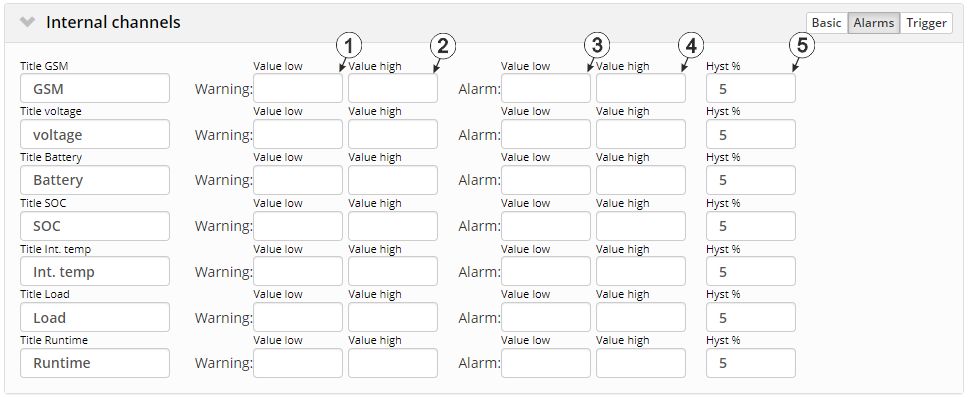
"Internal channels" configuration section, "Alarms" tab
| 1 | A warning is triggered, if the measurement value drops to or below this value. |
| 2 | A warning is triggered, if the measurement value meets or exceeds this value. |
| 3 | An alarm is triggered, if the measurement value drops to or below this value. |
| 4 | An alarm is triggered, if the measurement value meets or exceeds this value. |
| 5 | Hysteresis for all-clear in event of alarm/warning (e.g. Hyst=5 %, alarm or warning at 100 -> all-clear at 95) |
Trigger
There are two different types of triggers:
- Event trigger (RI, XM)
The relevant operation (e.g. initiate transmission) is only executed once when the trigger event occurs.
- Level trigger (ON, RA, QX)
The relevant operation (e.g. activate online mode) is executed as long as the trigger is active.

"Internal channels" configuration section, "Trigger" tab
| Event trigger: | ||
| 1 | Execute recording immediately | |
| 2 | Initiate transmission | |
| Level trigger: | ||
| 3 | Activate online mode | |
| 4 | The alternative record interval should be used. | |
| 5 | The alternative transmission cycle should be used. | |
| 6 | Selection if the corresponding action is to be performed upon exceeding or falling below the value entered in the "level" field | |
| greater or equal | Event trigger: The trigger is initiated if
the measurement value meets or exceeds this value. Level trigger: The trigger is active as long as the measurement value is higher than the level or equal to the level. |
|
| less or equal | Event trigger: The trigger is initiated if
the measurement value drops to or falls below this value. Level trigger: The trigger is active as long as the measurement value is lower than the level or equal to the level. |
|
| 7 | Levels for initiating the trigger. The hysteresis is used to determine the level to reset the trigger. | |
| 8 | Hysteresis for revoking the trigger (e.g. hyst=5 %, level = greater or equal, trigger at 100 -> all-clear at 95) | |


