Measurement method
The VEL‑R‑5 uses a pulsed, coherent radar that operates in the millimetre wave range.
"Pulsed" means that the VEL‑R‑5 emits a carrier wave for a short period of time. These signals are reflected by objects. The distance to the object can be calculated from the time difference between the emission of the signal and the reception of the reflected signal.
"Coherent" means that the reflected signal contains both amplitude and phase information. This allows even very small movements or speeds to be detected. "Coherent" also means that the start phase of the transmitted signal is known.
Advantages of radar technology
- Stable, reliable and extremely precise non-contact measurement of water levels and surface velocities
- Largely independent of the properties of the medium to be measured, such as temperature, viscosity, density or conductivity
- Insensitive to light conditions, fog and light rain; however, heavy rainfall significantly impairs measurement (see Framework conditions for a reliable measurement)
Surface velocity measurement
The algorithm used by the VEL‑R‑5 is similar to the way traditional radar devices measure speeds using the pulse Doppler effect. The velocity is determined based on the phase differences of the reflected signal. These phase differences are caused by minute movements of the waves during the measurement process. In order for the waves to be detected correctly, they must have a minimum height of 2 mm . The measurement accuracy is affected by standing waves, rain or wind.
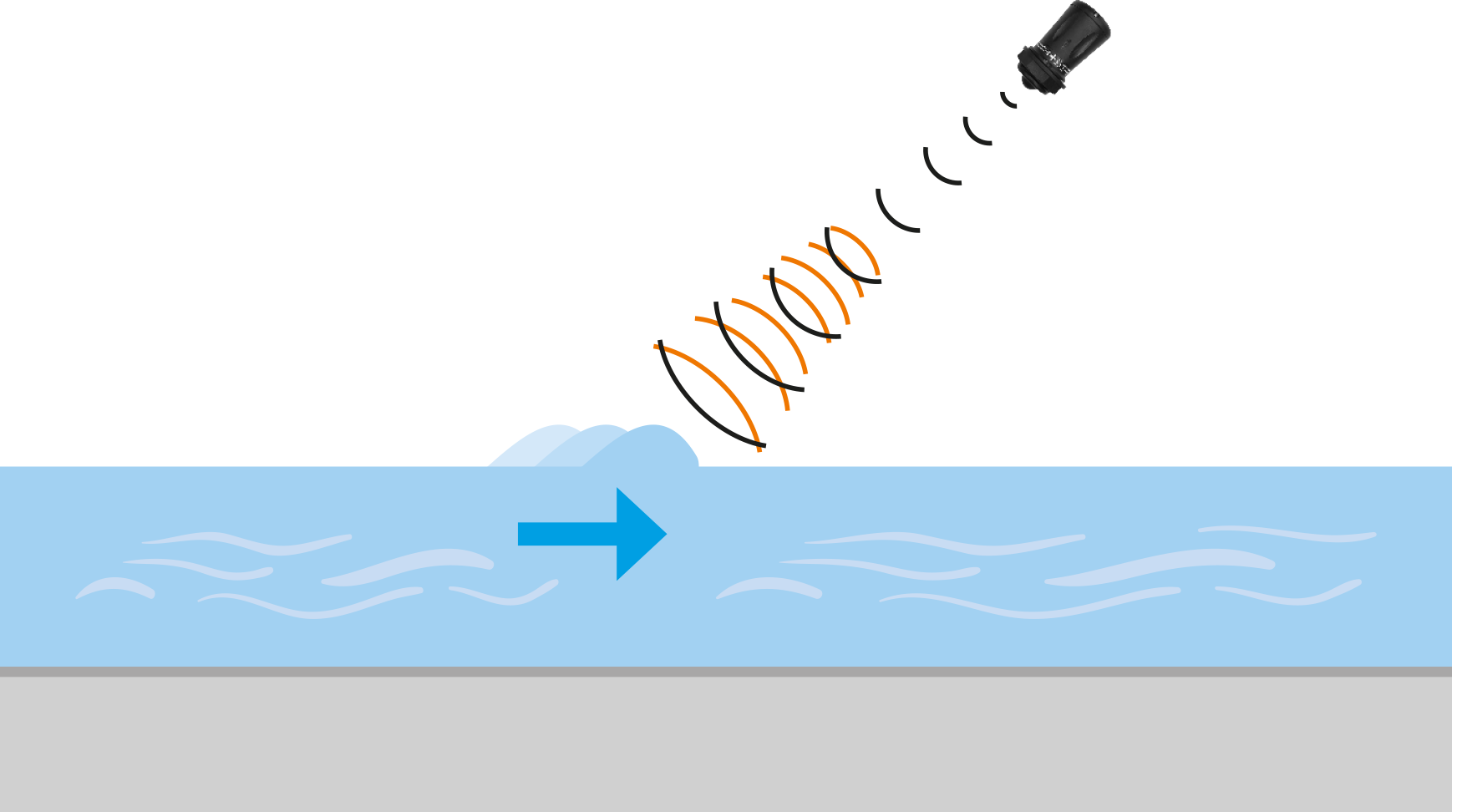
Schematic diagram of the measuring principle


