Measurement channels on the input extension
Configuration section to configure the settings for the 12 universal inputs on the myDatalogC3e 12UI/2Rel (i.e. on the input extension). The basic settings are configured in the "Basic" tab. The advanced configuration of the measurement channel is done via the "Configuration" tab, whereas the available caonfiguration parameters depend on the "mode" selected in the "Basic" tab. The "Alarms" tab is used to set alarm thresholds and the "Trigger" tab to determine the trigger thresholds as well as the actions to be performed in case the trigger conditions are met.
Basic
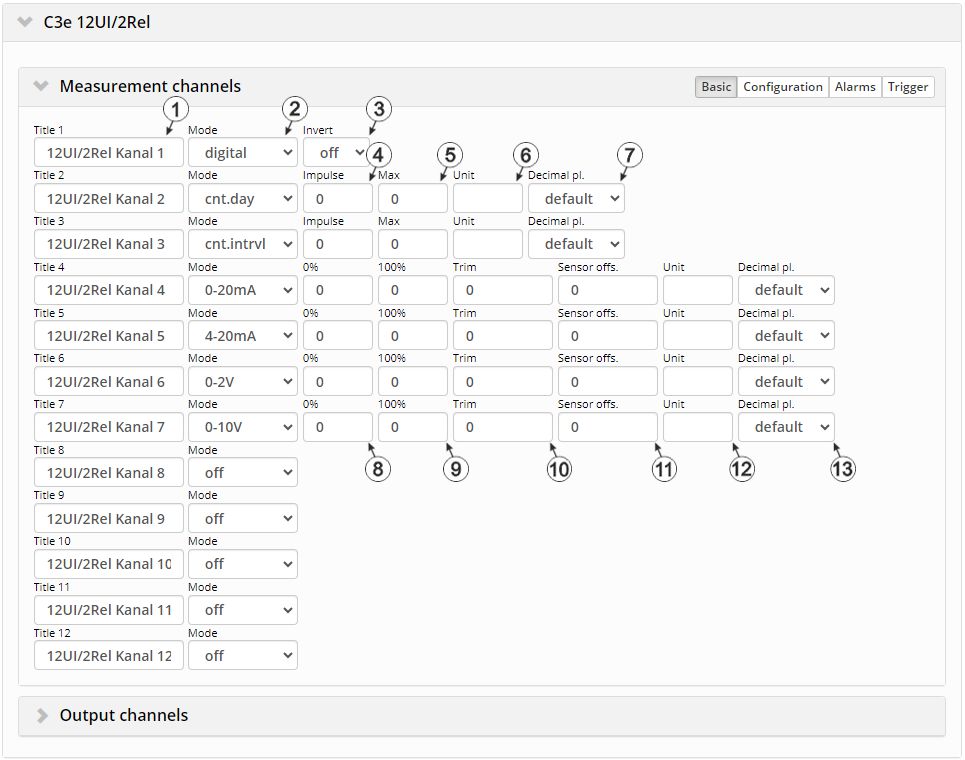
"Measurement channels on the input extension" configuration section, "Basic" tab
| 1 | Freely selectable channel title for the universal inputs | |
| 2 | Basic settings for the measurement channel | |
| off | Measurement channel deactivated | |
| xxx | Analogue and digital modes | |
| 3 | Inverts the input signal |
| 4 | Counted measurand of a pulse in the "Imp. unit" |
| 5 | Defines the upper scale end of the pointer instruments in reports |
| 6 | String that is used as a measurement unit by all of the server display elements [0‑16 8 characters] |
| 7 | Number of decimal places that are used by all of the server display elements |
1) The day counter is reset to the time zone selected via the "time zone" parameter in the "basic settings" configuration section (see Basic settings).
| 8 | Start of the measurement range in the measurement unit |
| 9 | End of the measurement range in the measurement unit |
| 10 | is used to adjust the zero point(see Additional explanation on the zero point adjustment and installation height of the sensor) |
| 11 | indicates the mounting height of the sensor |
| 12 | String that is used as a measurement unit by all of the server display elements [0‑16 8 characters] |
| 13 | Number of decimal places that are used by all of the server display elements |
Configuration
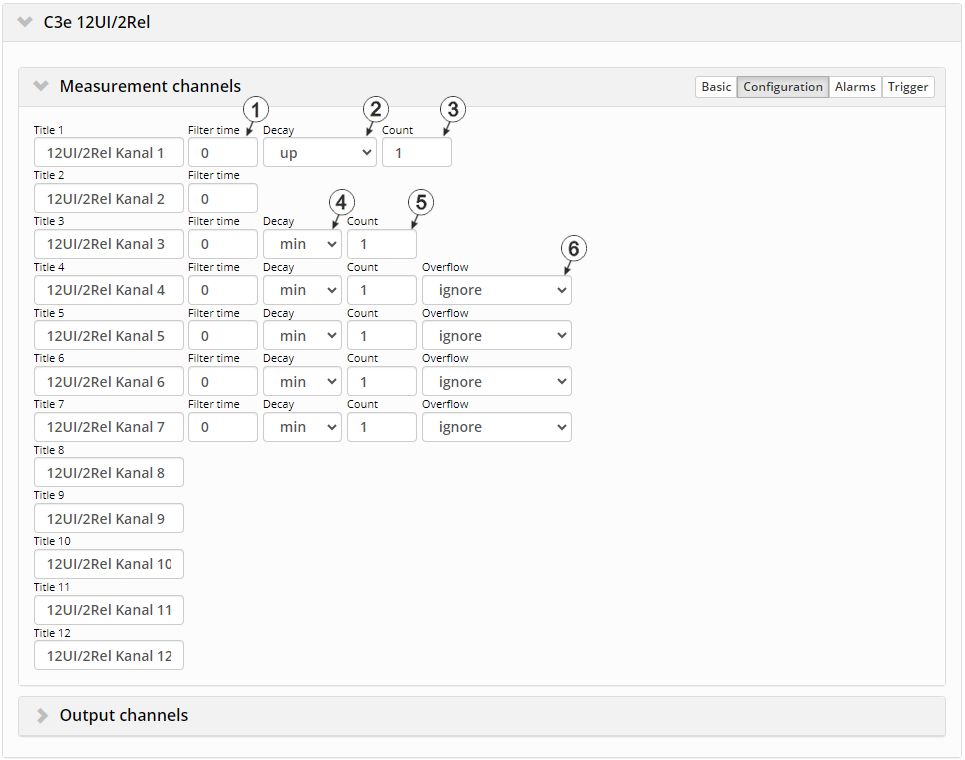
"Measurement channels on the input extension" configuration section, "Configuration" tab
| 1 | Time in [ms] during which the signal must remain constant to initiate a level change. Used to suppress brief faults (debouncing). | |
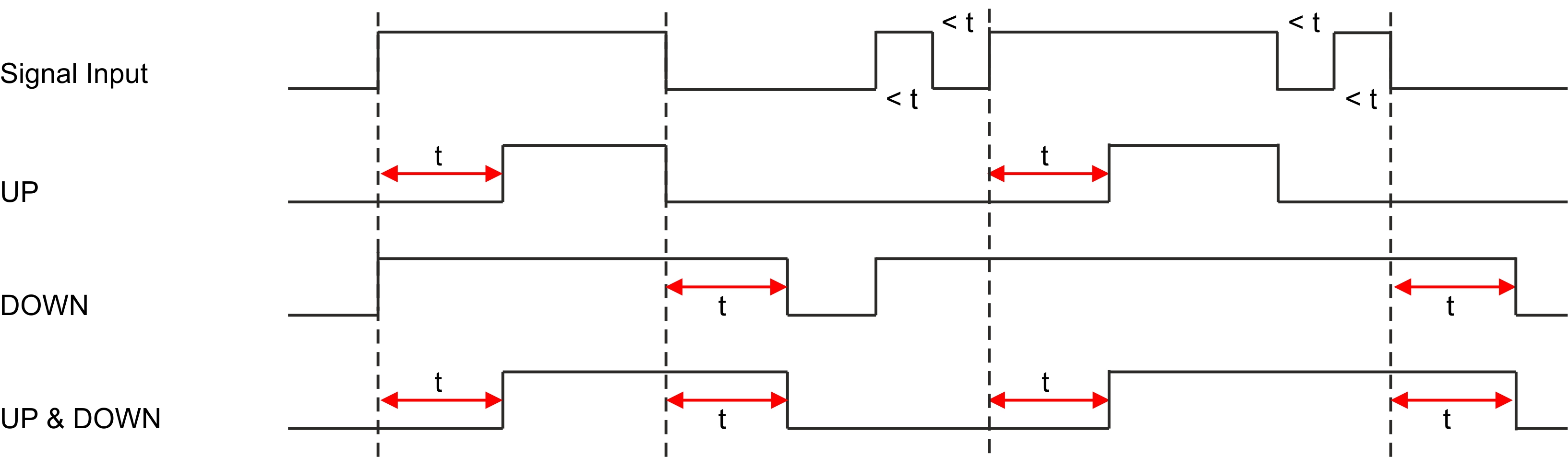
| 2 | Temporal function in the measurement cycle | |
| off | Decay deactivated | |
| up | At least x consecutive measurement values must be "High" for "High" to be recorded. | |
| down | At least x consecutive measurement values must be "Low" for "Low" to be recorded. | |
| up&down | At least x consecutive
measurement values must be "High" for "High" to be recorded.
At least x consecutive measurement values must be "Low" for "Low" to be recorded. |
|
|
||
| 3 | Number of measurement values taken into consideration during the decay (max. 64). In theses modes, a measurement value is created upon expiry of the measurement cycle and when the input signal level is changed. The changes to the inputs are monitored at one second intervals. | |
| 1 | Time in [ms] during which the signal must remain constant to initiate a level change. Used to suppress brief faults (debouncing). |
| 1 | Time in [ms] during which the signal must remain constant to initiate a level change. Used to suppress brief faults (debouncing). | |
| 4 | Temporal function in the measurement cycle | |
| off | Decay deactivated | |
| min | The minimum of the last x measurement values is recorded. | |
| max | The maximum of the last x measurement values is recorded. | |
| avg | The arithmetic mean of the last x measurement values is recorded. | |
| med | The median of the last x measurement values is recorded. | |
| rms | The root mean square of the last x measurement values is recorded. | |
| sum | The pulses are added up and are not reset every time a measurement value is generated but only after the measurement value has been recorded. This mode is thus recommended if the record interval is longer than the measurement cycle. | |
| 5 | Number of measurement values taken into consideration during the decay (max. 64). This configuration parameter is not available if "sum" mode was selected for the decay. | |
| 1 | Time in [ms] during which the analogue signal is averaged for signal smoothing. Used to suppress signal noise (also see Output channels on the myDatalogC3xx). | |
| 4 | Temporal function in the measurement cycle | |
| off | Decay deactivated | |
| min | The minimum of the last x measurement values is recorded. | |
| max | The maximum of the last x measurement values is recorded. | |
| avg | The arithmetic mean of the last x measurement values is recorded. | |
| med | The median of the last x measurement values is recorded. | |
| rms | The root mean square of the last x measurement values is recorded. | |
| 5 | Number of measurement values taken into consideration during the decay (max. 64). | |
| 6 | Procedure in the event of measurement range violations | |
| Ignore | The measurement value is calculated beyond the range limits. | |
| Silent cutoff | The measurement value is truncated at the range limits. | |
| NAMUR borders |
Mode "0-20 mA":
Mode "4-20 mA":
Mode "0-2 V":
Mode "0-10 V":
|
|
Alarms
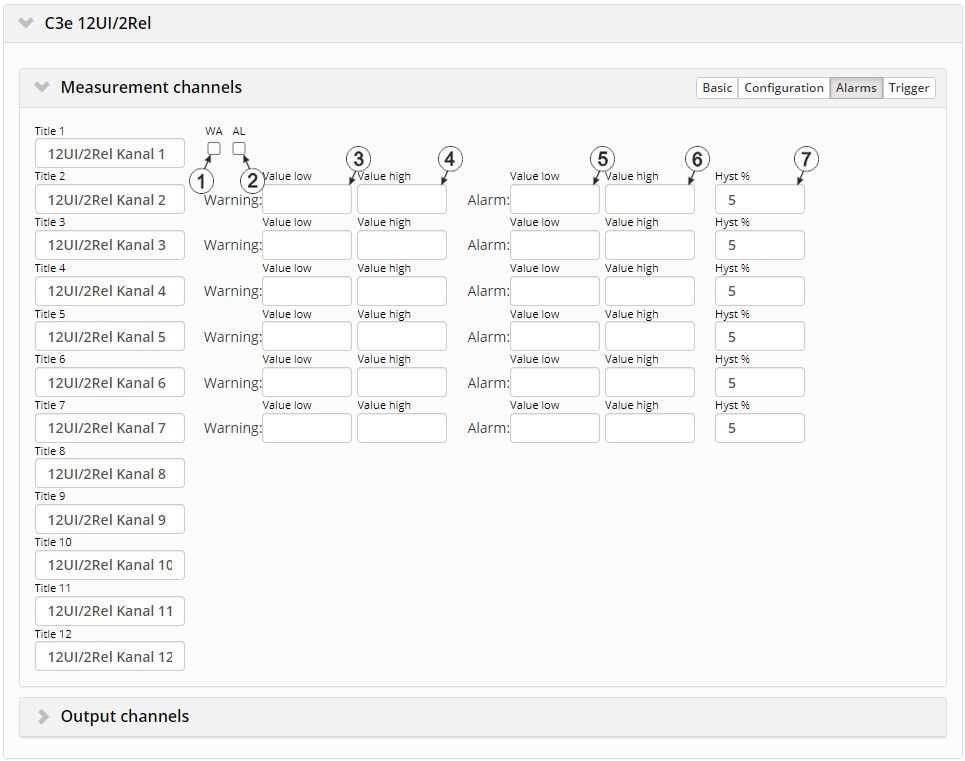
"Measurement channels on the input extension" configuration section, "Alarms" tab
| 1 | A "high" at the universal input triggers a "warning". |
| 2 | A "high" at the universal input triggers an "alarm". |
| 3 | A warning is triggered, if the measurement value drops to or below this value. |
| 4 | A warning is triggered, if the measurement value meets or exceeds this value. |
| 5 | An alarm is triggered, if the measurement value drops to or below this value. |
| 6 | An alarm is triggered, if the measurement value meets or exceeds this value. |
| 7 | Hysteresis for all-clear in event of alarm/warning (e.g. Hyst=5 %, alarm or warning at 100 -> all-clear at 95) |
Trigger
If an universal input is operated in digital mode, there are two different types of triggers:
- Event trigger (RI, XM)
In contrast to the level triggers, the relevant operation (e.g. record immediately) is only executed once when the trigger event occurs. With the help of the "Edge" configuration parameter, it is specified whether the rising, falling or both edges initiate the trigger event.
- Level trigger (ON, RA, QX)
A "high" at the universal input initiates the trigger. A "low" at the universal input resets the trigger. The relevant operation (e.g. use alternative record interval) is executed as long as the trigger is active. The option selected via the "Edge" configuration parameter is not relevant to the level trigger. If it is necessary for the trigger to be initiated by a "low" at the universal input and for it to be reset by a "high", the input signal must then be inverted using the "Invert" configuration parameter located in the "Basis" tab.
These two types of triggers are also differentiated in other universal input modes:
- Event trigger (RI, XM)
The relevant operation (e.g. record immediately) is only executed once when the trigger event occurs.
- Level trigger (ON, RA, QX)
The relevant operation (e.g. use alternative redord interval) is executed as long as the trigger is active.
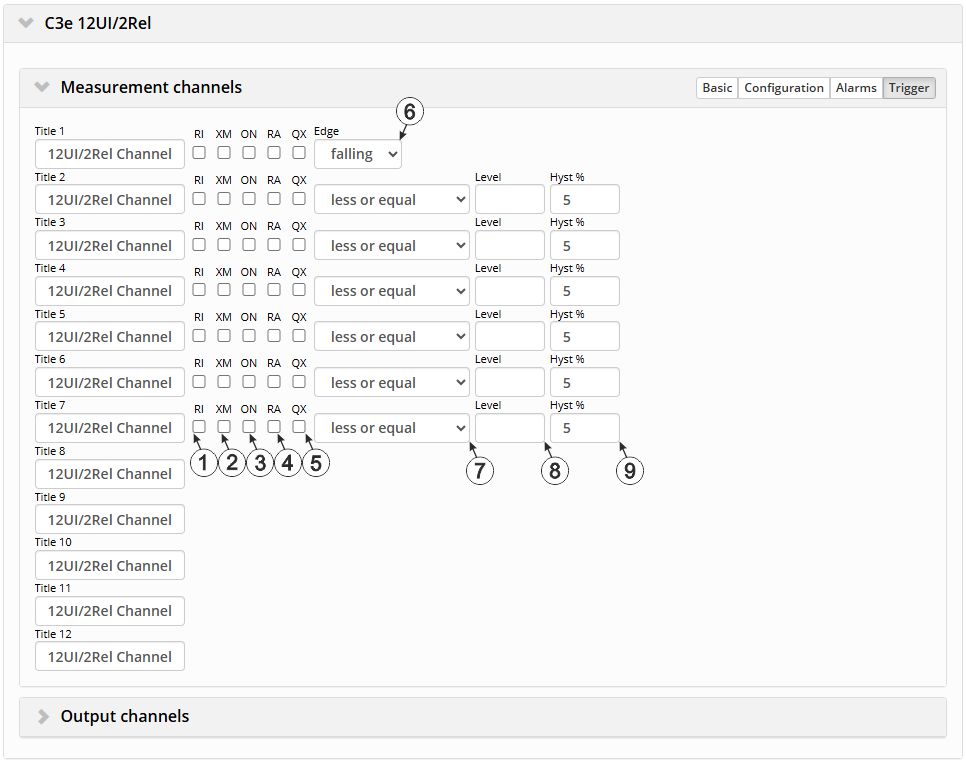
"Measurement channels on the input extention" configuration section, "Trigger" tab
| Event trigger: | |
| 1 | Execute recording immediately |
| 2 | Initiate transmission |
| Level trigger: | |
| 3 | Activate online mode |
| 4 | The alternative record interval should be used. |
| 5 | The alternative transmission cycle should be used. |
| 6 | Event trigger: Selection of the edge at which the trigger should be initiated Level trigger: not relevant |
|
| rising | The rising edge initiates the trigger. | |
| falling | The falling edge initiates the trigger. | |
| both | Both edges initiate the trigger. | |
| 7 | Selection if the corresponding action is to be performed upon exceeding or falling below the value entered in the "level" field | |
| Greater or equal |
Event trigger: The trigger is initiated if the measurement value meets or exceeds this value. Level trigger: The trigger is active as long as the measurement value is higher than the level or equal to the level. |
|
| Less or equal |
Event trigger: The trigger is initiated if the measurement value drops to or falls below this value. Level trigger: The trigger is active as long as the measurement value is lower than the level or equal to the level. |
|
| 8 | Levels for initiating the trigger. The hysteresis is used to determine the level to reset the trigger. | |
| 9 | Hysteresis for revoking the trigger (e.g. hyst=5 %, level = greater or equal, trigger at 100 -> all-clear at 95) | |


