Aligning the LVL-R-5
For the installation of the LVL-R-5 , mounting kits for various installation situations are available (see Assembly sets). The alignment of the LVL-R-5 with the flume to be measured is carried out for all flexibly adjustable mounts using the procedure described below. These can basically be divided into flexibly adjustable mounts and fixed mounts. Due to the fixed angle of 45° of the flow velocity sensor mount and the absence of joints, the rigid mounts offer less flexibility in aligning the sensors to the channel than the flexible mounts. However, they are significantly less sensitive to changes in sensor alignment due to the impact of external factors during operation.
Taking the expansion of the radar beamwidth into account
When the distance from the water surface increases, the sensor's detection range increases accordingly (see table in the chapter Framework conditions for a reliable measurement). If the LVL-R-5 is positioned unfavourably or in narrow channels, the berm may also extend into the sensor's detection range. In this case, both the water surface and the berm can produce reflections. This can cause the distance measured by the LVL-R-5 to jump between the distance to the water surface and the distance to the berm.
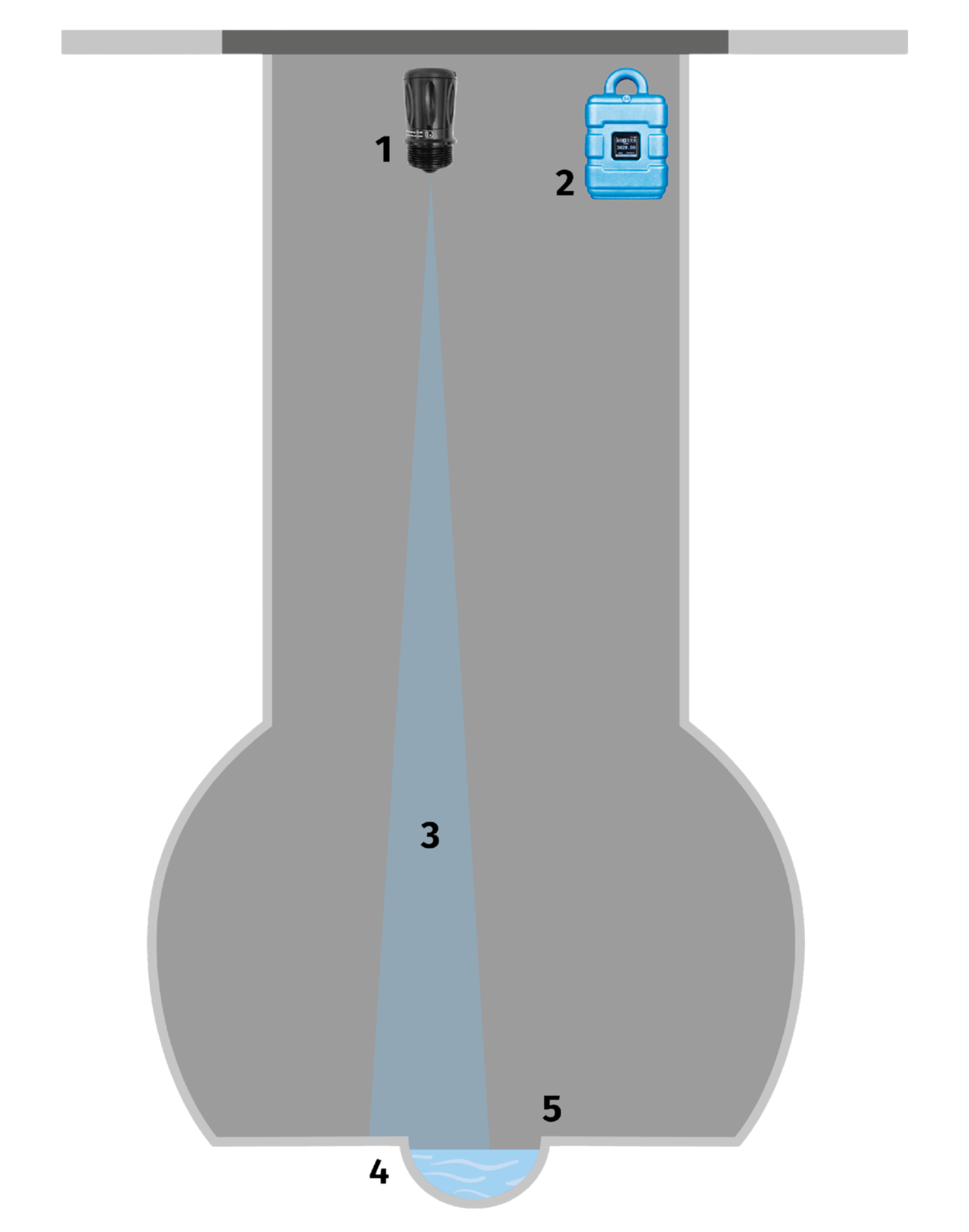
Measurement conditions in a narrow channel
| 1 | LVL-R-5 | 4 | Water level in flume |
| 2 | Compatible data logger | 5 | Berm |
| 3 | Radar cone (beam angle 4° ) |
The following measures can increase the reliability of the measurement:
- Improve alignment of the LVL-R-5 above the flume
- Reduce the mounting height to decrease the diameter of the detection range
Importance of the vertical alignment
The most accurate measurements are achieved when the LVL-R-5 is aligned exactly vertically. The built-in spirit level (see Overview) makes it easier to align the sensor precisely. Even slight tilts of the sensor can cause part of the transmitted radar signal to be deflected sideways and not reflected back to the LVL-R-5 . Furthermore, due to the angle of attack, the path travelled by the radar signal (i.e. the measured distance) no longer corresponds to the vertical distance to the water surface. This can lead to additional measurement deviations.
Depending on the mounting height and the angle of attack, the tilt of the LVL-R-5 also causes the sensor's detection range to shift. As a result, the edge of the channel or the berm may fall within the detection range, and the distance measured by the LVL-R-5 will alternate between the distance to the water surface and the distance to the berm (see Taking the expansion of the radar beamwidth into account).

Vertical vs. inclined sensor alignment
Final alignment
The final alignment of the LVL-R-5 with the flume to be measured is carried out for all flexibly adjustable mounts using the procedure described in section Flexibly adjustable mounts. When using a fixed mount, the procedure described in section Fixed mounts is to be used.


